
Experiencing the Divine Within
Why Knowledge Alone Never Satisfies — and What It Takes to Actually Realize the Divine

"Friend, why do you ask me what experience is?" — Vidyapati
"Kabir says: all else is transient; only direct experience is real. I have seen it with the veil lifted."
Throughout history, every great spiritual teacher has spoken of one thing above all else—experience. Whether we speak of God-realization, understanding humanity, art, or science, there is something that surpasses them all: direct inner realization. If we reflect honestly, we will find that whatever we pursue in life is, ultimately, an attempt to experience something deeply.
Let me put it simply. Whether our goal is to attain God, Truth, Existence, Eternity, Brahman, Shiva, or Narayana manifest in humanity, the fulfillment of that attainment rests upon our capacity for experience. Is that not so?
We may study Kant, Hegel, the Bhagavad Gita, the Bible, or the Quran. Yet if their truths never become living experiences within us—if they merely accumulate as information without harmonizing the knots of our own mind—the purpose of such study remains unfulfilled. Knowledge then becomes nothing more than a burden.
The Tangled Thread

Think of a tangled thread. When someone cannot untie the knot, they often pull harder. The knot may become smaller, but it also becomes tighter, making it even more difficult to loosen later. Our minds often suffer the same fate. Instead of resolving our impulses, desires, and conflicts, we continue to tighten them, layer upon layer. From this lack of resolution arises ignorance; from ignorance come fear, doubt, and sorrow.
The education that merely teaches us how to pass examinations is not the education I speak of. This is the education of life itself—the cultivation of experiential wisdom. Until we pass this school of life, the struggle continues, birth after birth.
Anubhuti: What Experience Actually Means

While reading Tapobidhayana by Sree Sree Thakur, I came across a remarkable line:
"Experience (Anubhuti) itself reveals its meaning. Anu means 'after,' and Bhuti means 'that which comes into being.'"
The moment I read these words, it felt as though a knot inside my own mind had been untied.
I realized that we can truly experience the One we seek only when our entire body-mind system becomes capable of receiving that experience.
Science offers a beautiful analogy. The sensors designed to detect visible light cannot perceive infrared radiation. Infrared waves exist, but their frequency lies beyond the capability of those instruments. To detect them, a more refined and finely tuned instrument is required.
The Instrument That Must Be Refined

Developing such refinement is not merely a matter of wishful thinking. It follows definite principles. Throughout history, different cultures, ages, and circumstances have developed different methods of applying those principles. Scientists understand this because they have learned through disciplined experimentation.
The same is true for the human being.
Our integrated body and mind constitute the finest instrument in existence. To fine-tune this instrument also requires definite principles and disciplined methods. Without them, true transformation cannot occur. Random experimentation may occasionally produce accidental achievements, but genuine mastery can never be attained through guesswork. More often than not, such guesswork causes harm rather than progress.
Human beings are the greatest instruments in creation, the very creators of all other instruments. The scientific process through which this human instrument is refined so that higher realization awakens within it is called Sadhana—spiritual discipline.
We must never forget a universal truth: everything yields its result only when done according to its proper method. We readily accept this principle in every other field of life, yet strangely forget it when it comes to ourselves.
Learning Sadhana from One Who Has Mastered It
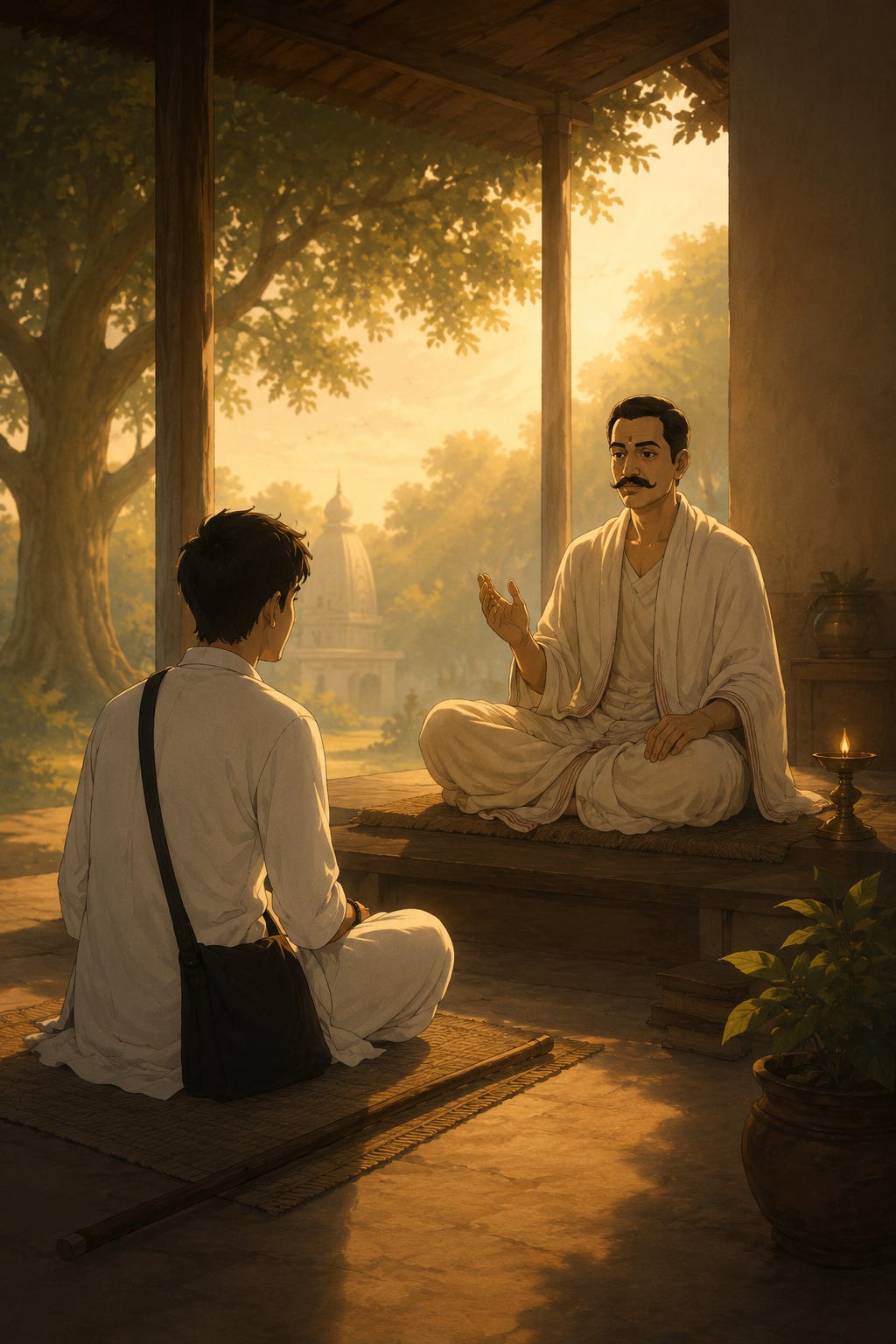
For this reason, the path of Sadhana must be learned from someone who has truly mastered it—someone properly trained through practice, who knows not merely the theory but the living exercise itself, and who possesses the ability to guide others.
Even then, words alone are not enough.
The radiance of genuine realization naturally expresses itself through every aspect of such a person's life—their speech, conduct, actions, and presence. Whether people consciously acknowledge it or not, a truly awakened personality invariably attracts attention. Every sincere seeker possesses enough discernment to recognize at least a glimpse of such authenticity.
Better still is to receive this discipline from One who is the very fountainhead of spiritual realization itself—One in whom supreme consciousness has manifested effortlessly from birth. Such a life displays an extraordinary continuity of realization from beginning to end.
Such a being is known by many names: the Living God, the Supreme Ideal, the Lord of Life, the Ishta-Guru, the Avatar of the Age, or the highest evolution of humanity—the infinitely loving Purushottama.
He is called the embodiment of supreme love because wherever such a being appears, one characteristic invariably shines forth first: He experiences every living being as an inseparable part of Himself. This is not learned behavior or cultivated morality; it is His spontaneous nature. Consequently, the expression of His love remains incomparable—an eternal, selfless stream flowing without condition.
There is another profound significance in learning Sadhana from such a being. Although He dwells in the highest realm of realization, He remains completely natural and fully human. Therefore, His teachings and disciplines are always perfectly suited to the needs, circumstances, and challenges of the age in which He appears.
Truth itself is eternal. Consequently, all genuine spiritual paths of the past naturally find fulfillment through contact with His integrated personality. It is for this reason that the sages sang:
"Sarvadevamaya Guruh Kalenanavacchedat"—the Guru embodies all divine manifestations, unrestricted by time.
Experience Cannot Be Borrowed

Yet none of this should be accepted merely because it has been heard.
Again and again I return to the same point: this is ultimately a matter of experience.
Experience means becoming in order to know.
And becoming is itself the result of doing.
What must be done is something one learns from a worthy, knowledgeable devotee or from an Ritwik who faithfully follows the Purushottama. Merely enrolling one's name and taking satisfaction in formal association accomplishes very little. One must remain unwavering in purpose, completely honest with oneself, and persevere with wholehearted sincerity.
Then comes the flower, and from the flower comes the fruit.
Otherwise, instead of attaining the fruit, one merely becomes a fool.
Diksha: The Formal Beginning

There is another point worth mentioning.
Just as formal education requires admission into a school, and marriage begins with a formal ceremony of acceptance, the spiritual journey also begins with a formal acceptance known as Diksha (initiation).
Many people may recoil at the very word. There are understandable reasons for this. Misrepresentation and superstition have obscured its true meaning, and genuine spiritual culture has often suffered as a result.
Nevertheless, what is essential cannot simply be discarded. One must examine carefully, test sincerely, and accept only what proves true.
Authentic initiation brings competence into life.
Just as there is a distinction between the spiritual practices of ordinary seekers and those of the Purushottama, there is also a profound distinction in initiation itself. The seer-scientists of the scriptures described the initiation bestowed by the Purushottama as Sat-Diksha—True Initiation.
Its emphasis is not on elaborate ritual. Rather, it rests upon steadfastness, loving obedience, active practice, and unwavering resolve.
Whoever serves as the medium of this Sat-Diksha performs the role of a sacred priest. The true initiator is none other than the Purushottama Himself. The entire system is designed upon this principle. He alone becomes the Sadguru, while the newly initiated disciple gradually deepens that relationship through sincere practice.
The Thakurhood Within

Returning now to the experience with which we began:
When the human heart attains inner discipline, harmony, and resolution through genuine realization, there awakens within it a sovereign completeness. This awakening is what may be called the Thakurhood within—the Divine Principle established in one's own heart.
Therefore Sree Sree Thakur Anukulchandra declared:
"Unless your own Thakurhood (Mastery Within) awakens, no one can truly become your center, nor your Thakur. If you deceive yourself, you alone will bear the consequences."
The words "your own Thakurhood (Mastery Within)" have always drawn my deepest attention. The more I contemplate them, the more they inspire me to say:
The seeker alone discovers the Beloved,
The refuge of every devoted heart.
Why fear, O seeker of the Ideal,
While searching through this world?
Rein in the restless river of desire;
Seek, seek the Supreme Reality.
Cross beyond the lake of wandering impulses,
Become absorbed in the living Ideal.
In the Ishta, the Guru, the Purushottama,
Union is certain.
Vande Purushottama!
(I bow to the Supreme Person.)